Hosted by Amphasys · Online · 16–17 September 2026

Amphacademy Pollen 2026

An opening keynote, six case studies from breeders, seed producers and researchers, and a 2023 encore — recorded across two afternoons in September.

Held
16–17 Sept 2026
Format
Online · two afternoons
Sessions
7 talks + one 2023 encore
Runtime
About 3¼ hours in total
What this edition covered

From pollen data to production decisions

Amphacademy is Amphasys’ annual get-together for the pollen community. Every session was a working case study — how a team used pollen quality analysis to answer a real question in breeding or seed production, and what they decided as a result. Applied, specific, and grounded in impedance flow cytometry (IFC).

Grounded in practice

Real trials, real fields, real production lines — presented by the people who ran them, from leading seed companies and universities.

Decision-relevant

The focus is on what the data changed: a protocol, a selection, a go/no-go.

Peer-to-peer

A curated international audience and generous Q&A — free to attend, and built for exchange rather than sales.

The recordings

Every session, on demand

Seven talks from Amphacademy Pollen 2026, plus the 2023 encore that was replayed on day one. Each talk runs 20–35 minutes, the encore about 15.

One short form, then everything plays. Tell us who you are once and all recordings on this page open — this time and the next time you come back.
Day 1Wednesday 16 September 2026
20:00 Unlock
Opening keynoteSwitzerland

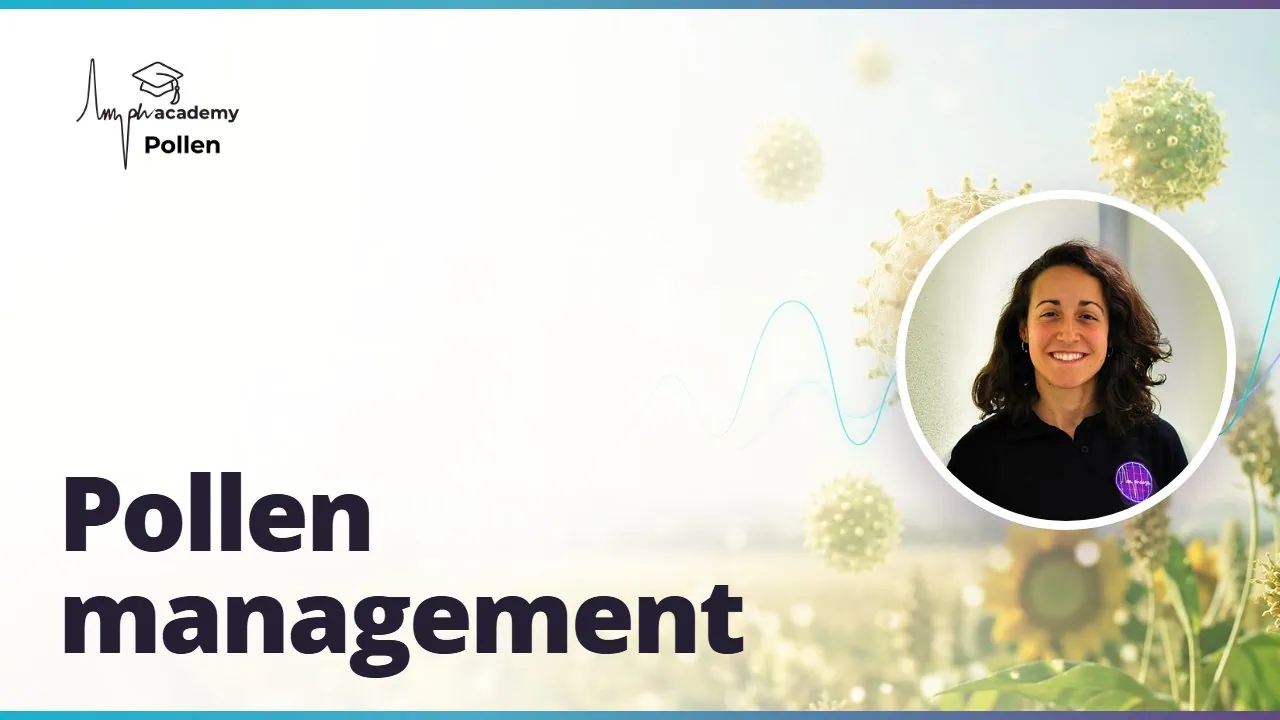
Pollen management: data-driven approaches to crop reproduction

An overview of how impedance flow cytometry turns pollen quality into decision-ready data — across vegetables, field crops, fruit trees and ornamentals. Marta shows how routine pollen viability and concentration screening supports real breeding and production choices, setting the scene for the case studies that follow.

Marta Pesquera
Regional Sales Manager, Amphasys AG
14:45 Unlock
Encore · 2023France

How Ampha P20 could simplify sunflower seed production
A case study from Amphacademy 2023, replayed on day one: how the pollen quality behaviour of sunflower inbred lines affects seed production potential, and how the sowing protocol or the production location can be adapted when pollen quality is poor.

Guillaume Vallin
Lidea (France) — recording from Amphacademy 2023
23:10 Unlock
Bell pepperSouth Africa

Bell pepper pollen viability: flower stage, handling, drying, storage temperature and duration

During routine harvesting in Starke Ayres’ pepper tunnels, one breeding line kept losing viability after drying and storage. This study traced exactly where the loss occurs — flower stage, handling, drying protocol, storage duration and temperature — and pinpointed drying as the main culprit, with sampling reliable and fridge and freezer performing equally up to 28 days.

Glendon Ascough
Research Director, Starke Ayres
22:19 Unlock
Sugar beetItaly

Pollen viability and the effect of storage treatments on sugar beet pollen

United Beet Seeds is mapping how sugar beet pollen changes through the blooming season, and how weather shapes its quantity and quality. The aim: reproducible protocols to collect, store and transport good pollen — right up to drone spraying. Alessia and Marino share their work on sampling, dehydration and storage.

Alessia Gardini & Marino Magnani
R&D Technician / Seed Production Manager, United Beet Seeds Italy
Day 2Thursday 17 September 2026
29:05 Unlock
Faba beanGermany

Effects of drought and heat stress on pollen development in faba bean (Vicia faba L.)

Faba bean yield is increasingly threatened by heat and drought during flowering. Using impedance flow cytometry across greenhouse, rain-out-shelter and open-field trials, Lisa shows how heat in particular cuts pollen production and viability — and how IFC revealed three distinct pollen groups: viable, non-viable and aberrant.

Dr. Lisa Brünjes
Plant Breeding Methodology, University of Göttingen
26:25 Unlock
Watermelon · ploidySwitzerland

Determining watermelon ploidy in the seed industry — one measurement, ploidy and viability together

In seedless watermelon production, triploid fruit comes from crossing tetraploid (4n) and diploid (2n) parents — so ploidy determination in that fertile parent material is a decisive step. Alexandra shows how impedance flow cytometry reads ploidy, pollen viability and aberrant cells from a single sample, and why that matters for breeding decisions and quality control.

Alexandra Abanto
Application Scientist, Amphasys AG
27:01 Unlock
Corn & sunflowerGermany

Assessment of pollen viability: approaches for production research in corn & sunflower

KWS built flow-cytometry pollen viability testing into its corn and sunflower production research: to investigate reduced fertilisation, to check whether pollen from partially sterile inbred lines is truly viable, and to study environmental and diurnal effects. The result is a robust, standardised way to screen pollen quality across breeding material.

Kristina Wunderle & Matthias Sättele
Production Research, KWS SAAT SE & Co. KGaA
34:29 Unlock
Forestry → fruitBrazil

Expanding the frontiers of pollen technology: large-scale supplementary mechanical pollination, from pine to fruit crops

Kolecti runs supplementary mechanical pollination at scale across forestry, field crops and fruit in Brazil. This talk shows how pollen quality assessment supports every step — from collection and storage to field application and process optimisation — and how it takes pollen technology beyond breeding into commercial agriculture.

Andreza Cerioni Belniaki
Operations & R&D Manager, Kolecti

Starting a video loads it from YouTube (Google Ireland Ltd.); your IP address is transmitted to Google in the process. Nothing is sent before you press play.

Stay in the loop

The pollen community meets once a year

Amphacademy Pollen is free to attend and comes round every year. Subscribe to the Amphasys newsletter and you will hear about the next edition first — along with the rest of what we publish on pollen quality.