Doubled Haploid Production Optimization
Microspore Analysis
Identify the correct microspore developmental stage to maximize efficiency in doubled haploid (DH) production.
The production of doubled haploid (DH) plants is a breeding technique for the accelerated development of homozygous lines. The process relies primarily on the isolation of microspores or anther cultures, chromosome doubling through chemical induction to restore fertility, and embryo regeneration under controlled tissue culture conditions.
Furthermore, since microspores in each anther can exhibit different developmental stages, and only the late uninucleate stage is capable of embryogenic induction, the precise identification of this late uninucleate stage significantly contributes to increasing the efficiency of the process.
As a result, Amphasys technology differentiates exactly each microspore developmental stage and thus increases efficiency in DH production.
Challenge:
Identification of the Late Uninucleate Stage

Microscopy, staining, and flower size assessment are rather imprecise methods and often present difficulties – depending on the crop – in accurately distinguishing between the subtle developmental stages of microspores. As a result, this leads to low reproducibility, highly variable induction rates, and overall low efficiency in the production of doubled haploids.
Amphasys technology replaces subjective and inaccurate estimations with rapid, label-free impedance flow cytometry for the immediate and precise analysis of the exact developmental stage of microspore cells. By objectively identifying the critical late mononuclear stage, the Ampha Z40 ensures reliable, data-driven decision-making for every sample. Because the cells are not damaged by the measurement, microspores can be reused for induction after measurement.
Challenge:
Reliable Microspore Embryogenesis Protocols

Following induction, microspores can react in various ways. However, the desired formation of embryonic microspores is only one possibility, and cell death is always a competing factor. In general, microspore viability decreases with the duration of culture, and the rate of cell death is highly variable; the exact cause of this is still unknown. Consequently, this variability in microspore culture complicates protocol optimization and the prediction of embryo formation.
Amphasys technology enables the temporal and factorial monitoring of the state (viability) of microspore embryo cultures. Using this technology, the amplitude variability of viable cells can be measured, and the regression of these early and late impedance measurements allows for the prediction of microspore embryogenesis.
The Right Tools for Microspore Analysis
Amphasys provides a fast, accurate, and label-free method to monitor and identify microspore developmental stages. Using impedance flow cytometry, the Ampha Z40 can distinguish microspores in early uninucleate, late uninucleate, and bi/trinucleate stages based on their biophysical properties.
This enables breeders to select the right anthers for extraction, improving induction rates and embryo formation.
Ampha Z40
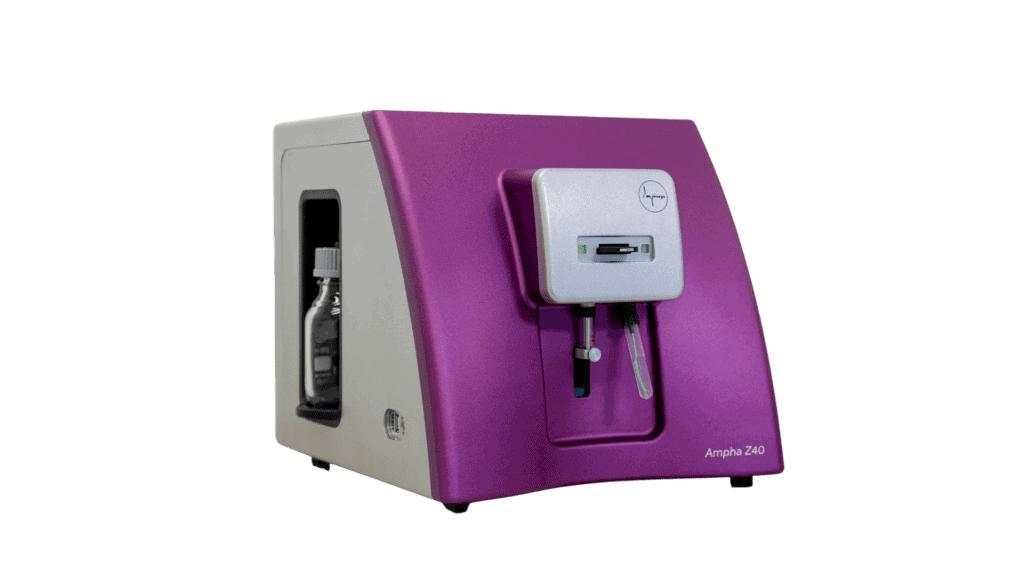
The Ampha Z40 enables objective, quantitative identification of microspore developmental stages through label-free impedance flow cytometry. It allows the analysis of microspores with minimal preparation and high throughput.
By clearly differentiating early uninucleate, late uninucleate, and bi/trinucleate stages, the Ampha Z40 supports reliable identification of the late uninucleate stage required for DH induction and ensures reproducible, data-driven selection decisions.
The Ampha Z40 allows to measure protoplasts and ovules as well.
AmphaChip
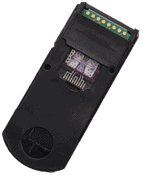
The microfluidic AmphaChips enable the rapid and easy analysis of microspores, protoplasts, and ovules. Detectors within the chip receive signals from cells passing through the electric field and are so sensitive that they can detect even subtle physiological changes in each cell, allowing for a precise characterization of its state, such as the different developmental stages of microspores.
How Microspore Analysis Works in Practice
Quantitative identification of microspore developmental stages as well as viability data enable breeders to transform doubled haploid production processes into a controlled, reproducible workflow with the prediction of microspore embryogenesis.
Targeted Selection for DH Induction
The Amphasys technology detects subtle physiological changes in microspores which correspond to their different developmental stages. Distinct developmental clusters correspond to specific microspore stages.
Applications
- Objectively identify early, late uninucleate, and bi/trinucleate microspores
- Improve induction success and embryo formation
- Select anthers and spikelets containing the optimal late uninucleate stage
- Improve efficiency of the overall doubled haploid process

Prediction of Microspore Embryogenesis
The efficiency of the whole doubled haploid process is limited by low and variable embryogenesis rates. The prediction of embryo formation can prevent waste of resources, labor, and unnecessary culture maintanance.
Applications
- Measure and monitor the viability of the selected microspores
- Correlate impedance measurement signals with embryogenesis
- Develop protocols according to the selected conditions
- Improve efficiency in difficult to culture crops

Bottom line: With Amphasys technology you gain instant insights into microspore status and development, enabling you to:

Clearly differentiate all microspore developmental stages

Predict microspore embroygenesis

Gain efficiency with high troughput measurements

Correlate microspore viability with embryogenesis success
Learn More
Deepen Your Knowledge & Drive Better Results
Download expert resources to dive deeper into the field of microspore embryogenesis, measurement technology, and real-world results.
Video
Accelerating Doubled Haploid Plant Production
In this video, Dr. Federica Assenza discusses a few ways in which impedance flow cytometry (IFC) can ease the obtainment of DHs via the androgenic pathway.
Video
Dissecting Variation in B. napus Microspores & Protoplasts
Discover how flow cytometry helps optimize doubled haploid production by analyzing microspore and protoplast cultures for viability and embryogenesis potential.
Video
Customer Success Story: Predicting Embryo Yields in Wheat Microspore Culture
Murielle Philippot, project manager in cell biology, will present the result of a study on the use of IFC during microspore culture in wheat.
















Frequently Asked Questions
Why is the late uninucleate stage critical for doubled haploid (DH) production?
Only microspores at the late uninucleate developmental stage are capable of undergoing embryogenic induction required for doubled haploid production. Microspores at earlier or later stages lack this potential, resulting in failed induction. Accurate identification of this stage is therefore essential to achieve high induction efficiency and reproducible DH production.
Why is manual microscopy insufficient for microspore staging?
Visual or microscopic examination helps to identify the uninucleate stage of microspores for further induction. However, neither viability nor subtle differences between microspores can be detected using these methods. This leads to low reproducibility and highly variable induction success rates.
Can all developmental stages of microspores be detected using impedance flow cytometry?
Yes. Impedance flow cytometry is a very sensitive method for detecting subtle differences in the state and composition of cells. Microspores undergo a developmental process in which they change their size and the composition of their cytoplasm. This can be detected and assigned to specific developmental stages.
Why is the prediction of embryo formation of such high relevance?
Predicting embryo formation is of great importance, as the rate of embryo formation determines the efficiency of the entire DH process. Since embryo formation typically occurs days or weeks after induction, significant time and resources can be saved if the conditions or stages leading to successful embryo formation can be identified.
How does automated microspore analysis reduce time and costs in DH production?
Early identification of unsuitable microspore developmental stages enables precise selection for induction, reducing material usage and avoiding unnecessary processing of material with low induction potential. Post-induction viability monitoring allows for the further processing of only promising samples. Since embryo formation is genotype-specific, impedance flow cytometry allows protocols to be adapted to each genotype.
Talk to a Microspore Expert
Ready to maximize your efficiency in doubled haploid (DH) production? Our experts are here to help you find the right solution for your specific needs.